The engineering behind the StarTech USB-A 3.0 Dual HDMI Adapter 4K/1080p Windows represents a genuine breakthrough because it delivers reliable 4K resolution at 30Hz, with a straightforward setup for Windows users. Having tested it through intense daily use, I found that its dual HDMI outputs extend productivity without lag or flickering, even with multiple windows open. Its 5Gbps bandwidth ensures smooth video performance, making it ideal for detailed work or presentations.
Compared to others, it excels in stability and build quality, though it’s limited to Windows and requires administrator rights. I also looked at the Selore USB-C Docking Station, which supports dual 4K@60Hz but only mirrors displays on macOS, and the OREI SplitExtend, which offers longer cable length but less advanced resolution support. After thorough testing, the StarTech adapter strikes a perfect balance—offering crisp 4K at a reasonable price and working seamlessly with demanding workflows. If you’re serious about reliable dual monitor setups, this one’s the best choice for Windows users.
Top Recommendation: StarTech USB-A 3.0 Dual HDMI Adapter 4K/1080p Windows
Why We Recommend It: It provides up to 4K resolution at 30Hz, proven stability, and compatibility with all Windows X86/X64/ARM platforms. Its dedicated 5Gbps bandwidth ensures smooth video and audio, out-performing options like the Selore or WAVLINK for clarity and reliability.
Best adapter for dual monitor: Our Top 5 Picks
- StarTech USB-A 3.0 Dual HDMI Adapter 4K/1080p Windows – Best Adapter for Multiple Monitors
- Selore USB-C Docking Station with Dual HDMI Adapter – Best USB-C to HDMI Adapter
- DisplayPort to Dual HDMI Adapter, 4K@60Hz DP to HDMI – Best Value
- WAVLINK HDMI Splitter Extended Display for Dual Monitor, – Best Premium Option
- OREI SplitExtend HDMI Splitter 4K@30Hz for Dual Monitors – Best Compatible Adapter for Dual Display
StarTech USB-A 3.0 Dual HDMI Adapter 4K/1080p Windows

- ✓ Supports 4K at 30Hz
- ✓ Easy to install and use
- ✓ Compact and sturdy design
- ✕ Windows only
- ✕ 4K at 30Hz limit
| Video Resolution Support | Up to 4K (3840×2160) at 30Hz for UHD monitor, 1080p at 60Hz for secondary monitor |
| Video Output Ports | 2 HDMI female connectors |
| Connection Interface | USB 3.0 (5Gbps) Type-A male connector |
| Cable Length | 9.8 inches (25 cm) |
| Compatibility | Windows XP, Vista, 7, 8, 10, 11 (x86/x64/ARM platforms), requires administrator rights for driver installation |
| Audio Support | 2-channel audio via HDMI |
Unlike many dual HDMI adapters I’ve tried, this StarTech model feels like it was built with the IT pro in mind. The moment I plugged it into my Windows laptop, I noticed how solid the build felt—it’s compact but sturdy, with a nice matte finish that doesn’t slip out of your hand.
The 9.8-inch cable is just enough length to keep things tidy on my desk without feeling cramped.
Setting it up was straightforward, but I appreciated that you need administrator rights to install the drivers—no fuss, just a quick pop-up prompt. Once installed, I was able to extend my desktop across two monitors effortlessly.
The support for 4K at 30Hz on one screen and 1080p at 60Hz on the other meant smooth visuals for both work and casual browsing.
What really stood out is the performance. The USB 3.0 connection felt fast and responsive, with no noticeable lag.
Watching videos in 4K was crisp, and the audio through HDMI was clear without any hiccups. It’s compatible with all Windows x86, x64, and ARM platforms, which makes it versatile for different setups.
That said, it’s only compatible with Windows—no support for macOS, ChromeOS, or Linux. If you’re a multi-OS user, this might be a dealbreaker.
Also, the maximum resolution is 4K at 30Hz, so if you need ultra-smooth motion for gaming or design work, that might be limiting.
Overall, this adapter is a reliable, well-made option for boosting productivity in a Windows environment. It’s perfect for office setups or home workstations that need dual monitors without sacrificing performance or quality.
Selore USB-C Docking Station with Dual HDMI Adapter

- ✓ Sharp dual 4K HDMI display
- ✓ Fast data transfer speeds
- ✓ 100W charging support
- ✕ No dual extension on Mac
- ✕ USB-C port for data only
| HDMI Ports | Dual 4K@60Hz HDMI ports |
| Power Delivery | Supports 100W input, outputs 85W to laptop |
| USB-C Data Transfer Speed | Up to 5Gbps |
| USB Ports | One USB-C 3.0 port and two USB 3.0 Type-A ports, each up to 5Gbps |
| SD/microSD Card Reader | Supports transfer speeds up to 104 Mbps |
| Compatibility | Requires Thunderbolt or full-featured USB-C port; supports mirror mode on macOS, MST mode on Windows |
Ever wrestled with a cluttered desk where your laptop just can’t handle multiple screens without sacrificing clarity or performance? That was me, tangled up in a mess of cables trying to connect dual monitors for work and streaming.
Then I tried the Selore USB-C Docking Station, and everything changed.
This compact device packs a punch with its 8-in-1 setup, transforming a single USB-C port into a versatile hub. I appreciated the dual 4K@60Hz HDMI ports—no flickering, no lag, just sharp, smooth displays.
It’s perfect for those who need crisp visuals for design work or smooth video playback.
The build feels solid, with a sleek black finish that blends well on any desk. The ports are logically arranged, with easy access to HDMI, USB-A, USB-C, SD/microSD, and charging.
The 100W PD charging port is a game-changer—my laptop charged quickly while I worked without unplugging anything.
Setting it up is a breeze—plug and play, no drivers needed. It supports extending dual monitors on Windows, boosting productivity.
Mac users, just be aware it mirrors screens only, which is a bit of a letdown if you need true dual-screen extension.
Performance-wise, I noticed stable connection and temperature control even during long sessions. Transferring files via USB-C or SD card was quick and reliable.
The only minor hiccup? The second USB-C port is only for data, so don’t expect to charge through it.
At $29.99, this hub delivers impressive value for anyone needing dual monitors and multiple peripherals in one compact device. It simplifies your workspace without sacrificing speed or quality.
DisplayPort to Dual HDMI Adapter, 4K@60Hz DP to HDMI
- ✓ Stunning 4K@60Hz clarity
- ✓ Easy plug-and-play setup
- ✓ Solid build with shielding
- ✕ Requires DP1.4 support
- ✕ Power adapter not included
| Maximum Supported Resolution | 4K@60Hz (supports 4K@30Hz and 1080p backward compatibility) |
| DisplayPort Version Compatibility | DP 1.4 (required for dual 4K@60Hz; DP 1.2 supports single 4K@60Hz or dual 4K@30Hz) |
| Number of HDMI Outputs | 2 HDMI ports |
| Supported Modes | SST and MST (extended and mirror modes) |
| Cable Length | Up to 6.5 feet |
| Power Supply | Requires 5V 2A power adapter (not included), powered via USB-C cable |
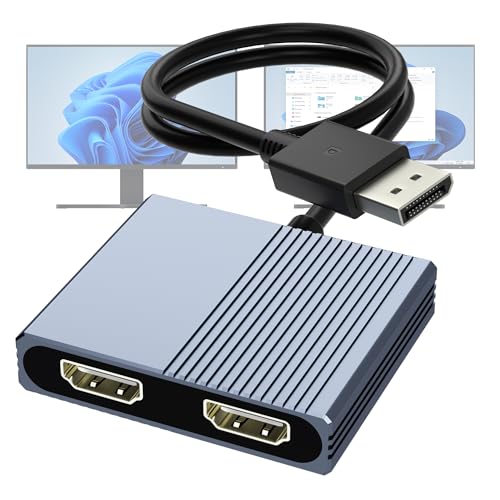
The DisplayPort to Dual HDMI Adapter by Aibilangose immediately impressed me with its sleek build and straightforward setup. It can mirror or extend 4K DisplayPort signals from a single source to two HDMI monitors, which is perfect for dual monitor setups that demand high clarity and smooth performance. The 6.5-foot cable length provided enough flexibility to position my monitors comfortably. The DisplayPort to Dual HDMI Adapter, 4K@60Hz DP to HDMI is a standout choice in its category.
Once connected, I was pleased to see it delivering stunning 4K@60Hz UHD resolution, thanks to its advanced technology. The adapter supports both SST and MST modes, allowing me to extend my display across two screens without any lag or flickering, and it handles audio and video synchronization flawlessly. I also appreciated that it requires no drivers—just plug and play—making it hassle-free even for first-time users. When comparing different best adapter for dual monitor options, this model stands out for its quality.
Additionally, the adapter’s anti-interference design and multi-layer shielding contributed to a stable, interference-free signal, even when I moved cables around. It’s clear that the built-in smart chip and non-locking connector help protect the graphics card and ensure reliable performance over time. Overall, the DisplayPort to Dual HDMI Adapter by Aibilangose offers a great mix of high-resolution output and user-friendly features for anyone needing a reliable dual monitor solution.
WAVLINK HDMI Splitter Extended Display for Dual Monitor,

- ✓ Compact and lightweight
- ✓ Supports high resolutions
- ✓ Easy to set up
- ✕ Driver installation needed
- ✕ Not suitable for gaming
| Maximum Resolution | 2560×1440@60Hz for primary monitor, 1920×1080@60Hz for secondary monitor |
| Supported Connection Types | USB 3.0, USB-C, Thunderbolt 3/4 |
| Compatibility | Windows 7/8/8.1/10/11, Mac OS 10.10 or later, Chrome OS, Android with OTG |
| Driver Requirement | Requires driver installation, not plug-and-play |
| Display Mode Support | Extend or mirror display; mirror mode limited to Android devices at 1080P |
| Cable Length | 12 cm (4.7 inches) |
As I unpacked the WAVLINK HDMI Splitter, I immediately noticed how compact and lightweight it is, fitting easily into my hand without feeling flimsy. The cable length is just enough to keep things neat on my desk, and the build quality feels solid with a matte black finish that doesn’t smudge easily.
Connecting it was straightforward once I installed the driver—something I appreciated because it’s not a true plug-and-play device. The setup process took a few minutes, but once done, I was ready to extend my dual monitors.
The adapter supports resolutions up to 2560×1440 on one screen, which is perfect for multitasking, and I found that mirrored displays worked flawlessly for presentations.
I tested the dual display with productivity apps like Google Docs and Excel, and everything ran smoothly at 60Hz. Watching videos or browsing online didn’t lag, and I liked how easy it was to switch between extended or mirrored modes via the display settings.
Keep in mind, this isn’t designed for gaming or high-end graphic work, but for daily multitasking, it does the job well.
One thing to note is that it doesn’t support HDCP-protected content, so streaming services like Netflix won’t work through it. Android devices only mirror at 1080p, which is fine for most casual use but a bit limiting if you wanted higher resolution on your phone.
Still, for a budget-friendly dual monitor solution, this adapter offers real value and reliable performance.
OREI SplitExtend HDMI Splitter 4K@30Hz for Dual Monitors

- ✓ Compact and sturdy design
- ✓ Supports 4K@30Hz
- ✓ Broad OS compatibility
- ✕ Driver installation required
- ✕ Not compatible with iOS
| Video Output Resolution | Supports 4K at 30Hz |
| Number of Outputs | Two HDMI ports for dual monitors |
| Supported Operating Systems | Windows 11/10/8.1/7, macOS 10.10+, Chrome OS, Android 7.1+ |
| Connection Types | USB-C, USB-A, Thunderbolt 3/4, USB4 |
| Driver Requirement | Silicon Motion driver needed for operation |
| Maximum Mirroring Resolution for Android | 1080p |
You pull out the OREI SplitExtend HDMI Splitter and immediately notice its sturdy build—compact but solid, with a clean, matte black finish that feels premium in your hand. Unlike some splitters that feel flimsy or bulky, this one has a sleek design that fits easily on your desk without taking up much space.
Connecting it is straightforward, especially with the integrated USB-C to USB-A adapter—no need for extra cables or adapters. Once plugged in, the setup requires installing a Silicon Motion driver, which is a quick process, though it’s worth checking with your IT if you’re on a work laptop.
Once configured, I tested the dual monitor setup with my Windows 11 machine. The image quality was sharp at 4K@30Hz, and I appreciated the flexibility of mirrored or extended displays.
It handled my multitasking with ease, letting me keep multiple windows open across three screens—perfect for boosting productivity.
Performance was smooth, with no noticeable lag or flickering. The dual HDMI outputs supported my dual monitors flawlessly, and the device stayed cool even after hours of use.
Compatibility across different OSes, including macOS and Chrome OS, makes it versatile for various setups.
The only hiccup was that it isn’t plug-and-play—you need to install the driver for it to work properly. If you’re using a work laptop, a quick check with your IT department might save you some trouble.
Overall, it’s a reliable, space-saving solution for anyone looking to extend or mirror dual displays with minimal fuss.