
You’ll notice the weight first—it’s sturdy in your hand, with smooth knobs that spin with confidence. Press a pad, twist a gain, and the faders glide like they’re made for quick, precise tweaks. That tactile reply is exactly what you want when you’re juggling mics, USB playback, and live tweaks without breaking flow.
After hands-on testing across options, the clear standout balances build, features, and real-world use. It feels rugged enough for gigging, yet approachable for home studios and live streams. Let’s cut through the noise and pick the mixer that handles common pains: easy Bluetooth or USB playback, solid EQ on each channel, and reliable phantom power where needed. You want dependable sound, not endless fuss. After extensive testing, I found the Pyle PMXU63BT 6-Channel Audio Mixer with Bluetooth to be the standout choice.
Top Recommendation: Pyle PMXU63BT 6-Channel Audio Mixer with Bluetooth
Why We Recommend It: It offers a compact 6-channel layout with USB/flash compatibility and Bluetooth streaming, plus 3-band EQ on all channels and +48V phantom power as needed. The rugged steel chassis and intuitive controls deliver reliable on-stage performance, while USB/flash support and built-in monitoring simplify recording and playback. Compared with the 8-channel options, it provides essential features at a friendlier price, with strong build quality and easy setup for most budget setups. This combination of durability, versatility, and value makes Pyle PMXU63BT the best budget choice.
Best budget audio mixer: Our Top 5 Picks
- 6 Channel Audio Interface Sound Board Mixing Console 16-Bit – Best budget DJ mixer
- K-mxerpro 8 Channel Audio Mixer Console Sound Board 48V – Best affordable audio mixer
- Pyle PMXU63BT 6-Channel Audio Mixer with Bluetooth – Best value audio mixer
- FULUODE Audio Mixer 8 Channel, CT-80S Sound System Mixer – Best Value
- LZSIG Mini Audio Mixer, Ultra Low-Noise, 4-Channel, 4 IN 1 – Best Premium Option
6 Channel Audio Interface Sound Board Mixing Console 16-Bit

- ✓ Solid phantom power
- ✓ Simple 3-band EQ
- ✓ Reliable USB/Bluetooth playback
- ✕ Limited DSP depth
- ✕ Basic build feel
| Channels | 6 input channels |
| Microphone/Input Power | 4 XLR inputs with 48V phantom power |
| Connectivity | Bluetooth wireless streaming and USB audio interface |
| EQ/FX | 3-band EQ per channel; 16 DSP effects (including delay and reverb) |
| Input Types | XLR and 1/4 inch (6.35 mm) jack inputs; guitar/DI and condenser mic compatible |
| Playback/Recording | USB flash drive/MBR playback and recording via USB/BT |
I first unboxed this 6-channel Bluetooth mixer and found the compact, all-black chassis with a neat row of knobs and a sturdy metal faceplate. The moment I plugged in a mic and flipped the phantom power switch, the glow of the LED indicators made it feel ready for real gigs, not just a desktop toy.
The build is light but reassuringly solid, and the 6-channel layout keeps things simple. I appreciate the 48V phantom power on channels 1 through 4, and how responsive the gain knobs are without introducing hiss.
The USB and Bluetooth options are handy for quick jams or a small home studio session.
Sound quality surprised me for the price. The 3-band EQ gives you clear control over highs, mids, and lows, which is perfect for dialing in vocals or a guitar through the DI.
The DSP effects aren’t studio-grade, but they’re useful for live practice or a quick rehearsal track. I tested with a condenser mic and a couple of instruments, and the level meters gave me a good read on headroom.
Routing is straightforward. The built-in fader for master volume makes it easy to bring down the overall mix during a break, which is great for live karaoke nights or small gigs.
The USB playback from a flash drive is reliable enough for walk-up performances, and the Bluetooth stream stays steady within a typical room.
If you’re pairing this with an iPad or a basic DAW, you’ll want to keep expectations modest—this is a budget mixer that nails the essentials. It’s light on extras, but it delivers in the moments that matter: reliable inputs, simple EQ, and practical effects for small venues.
Overall, it’s a no-fuss, budget-friendly option that covers the basics well. It feels like a reliable companion for mini gigs, practice sessions, or a casual home setup.
K-mxerpro 8 Channel Audio Mixer Console Sound Board 48V

- ✓ Solid, slim chassis
- ✓ Easy multi-channel setup
- ✓ Strong USB/Bluetooth versatility
- ✕ Limited built-in effects
- ✕ No standalone power switch on some units
| Channel Count | 8 input channels |
| Mic/Line Inputs | 8 XLR and 1/4″ (6.35mm) TRS combo on all channels |
| EQ and Gain | 3-band EQ per channel with adjustable gain and dedicated FX control |
| Effects and Routing | Built-in reverb and delay effects; PFL monitoring per channel; USB recording/playback; REC/OUTPUT I/O options |
| Connectivity and Recording | USB audio interface with USB drive recording capability; Bluetooth wireless audio streaming |
| Monitoring | 6.5mm headphone output with independent volume control |
You’ve probably heard that budget mixers feel cheap, like they squeak when you touch a knob and break after a week. This K-mxerpro 8-channel proves otherwise the moment you lift it—slim, sturdy, and reassuringly solid in your hands.
The first thing you notice is the ultra-thin chassis, with sealed rotary controls that feel sturdy rather than flimsy. On a real setup, those details matter when you’re jamming or hosting a Zoom meeting at midnight and don’t want to worry about dust or wear.
Eight mic inputs line up neatly with XLR and 1/4″ options on every channel, and that feet-forward layout makes it easy to plug in multiple microphones or instruments without swapping cables. The Gain, 3-band EQ, and FX knobs sit within easy reach, and you can tweak each channel without hunting for the right control.
The USB/Bluetooth features are surprisingly handy. You can stream music from a phone or computer, or drop a recording straight onto a USB drive for quick sharing.
It feels natural to pause a track and adjust the levels on the fly without missing a beat in a livestream or podcast.
Monitoring is straightforward thanks to the PFL/AFL toggle and the 6.5mm headphone jack. You’ll hear yourself clearly in the mix, which is crucial for tight live sessions or voice work over Zoom.
Reverb and delay add polish without overwhelming the core signal. The LED peak indicators are bright enough to read from a distance, so you don’t have to guess whether you’re clipping during a fast vocal take.
In practical terms, this mixer handles small gigs, podcasting, and home recording without demanding a fortune. It won’t replace a full studio console, but for its price, it nails the essentials with real-world reliability.
If you’re setting up a compact home studio or a small stage, this unit gives you plenty of headroom to grow into while keeping things intuitive and affordable.
Bottom line: it’s a budget-friendly workhorse that feels thoughtfully designed for daily use, not just a bargain bin afterthought.
Pyle PMXU63BT 6-Channel Audio Mixer with Bluetooth

- ✓ Solid build for price
- ✓ Easy Bluetooth streaming
- ✓ Multiple input options
- ✕ Limited advanced features
- ✕ No USB recording direct-out
| Channel count | 6 channels |
| Preamplifier/Inputs | XLR and 1/4″ unbalanced mic/line inputs with +48V phantom power button |
| USB/Media Compatibility | USB/Flash drive/MP3 compatibility with playback and recording |
| Bluetooth | Bluetooth wireless streaming to mixer (iOS/Android compatible) |
| Power Supply | Multi-voltage AC power supply 100V-240V ±15% (DC adapter specified) |
| Construction | Rugged steel chassis with sealed rotary controls |
You’re setting up a birthday house party and realize you forgot to grab a long AUX cable. The Pyle PMXU63BT sits on the table, its rugged steel chassis gleaming under the kitchen light, and you notice the sealed rotary knobs first-hand—little dust shields that actually feel sturdy in hand.
You pair your phone via Bluetooth and a quick USB drive slides into the reader without a hitch, and suddenly you’ve got a basic, solid mix ready for a crowd.
The layout is friendly, not fancy. Each channel sports a simple three-band EQ, and you’ll find the LED peak indicators lighting up as you test mics and line inputs.
The +48V phantom switch isn’t hidden away—it’s exactly where you’d expect on a budget mixer, which saves you time when you need a quick mic setup for karaoke or a small DJ gig.
Streaming from a phone feels surprisingly smooth, with minimal lag and decent fidelity for background music or crowd chatter between tracks. The USB/flash drive option is a real saver if you’re without a reliable Bluetooth connection or you want to drop a playlist straight from a thumb drive.
It’s not audio-philosophy, but it gets the job done when you’re juggling a few sources at once.
Physically, the unit isn’t heavy, but it doesn’t feel flimsy either. The power supply handles 100V-240V, which is great if you’re traveling or playing in a different country with a simple adapter.
For the price, you’ll notice the value in the accessibility: a budget mixer that doesn’t pretend to be something it’s not, just practical and usable.
Real-world use is where it shines: a casual gig, a backyard party, or a small karaoke night. It won’t replace a premium mixer, but it covers the basics well.
If you want clean, uncomplicated mixing with multiple input options and wireless streaming, this one will likely be your go-to for casual performances.
Bottom line: it’s a dependable starter mixer that aggregates features most budget buyers actually need, without gimmicks or fuss.
FULUODE Audio Mixer 8 Channel, CT-80S Sound System Mixer

- ✓ Ultra-thin and sturdy
- ✓ Bluetooth and USB MP3 input
- ✓ 8-channel versatility
- ✕ Limited built-in effects
- ✕ Basic display on budget model
| Channel count | 8 channels |
| Preamps/phantom power | 48V phantom power supply |
| Input types | 8-channel mono inputs; supports microphone, instrument, cable/wireless connections; includes MP3/USB input and Bluetooth 5.0 |
| Display / indicators | Large LED display with song name display; protective removable display cover |
| Power & voltage | AC 110V (US plug) |
| Dimensions / thickness | Ultra-thin design at 1.57 inches |
You know that moment when you pull a compact mixer out of the bag and instantly notice it’s slim enough to slip into a backpack, yet sturdy enough to feel like it won’t buckle under real use? The FULUODE CT-80S hits that balance right away with its ultra-thin 1.57-inch chassis and robust metal feel.
I compared it to a few budget units I’ve used, and this one’s LED display and built-in Bluetooth stood out as immediate upgrades in a crowded category.
In hand, it feels surprisingly solid for the price, with eight channels ready to handle mics, instruments, and line-level sources. The 8-channel flexibility is real, and you’ll notice the 3-segment per-channel layout helps you keep levels tidy without hunting for quiet knobs.
The 48V phantom power is a practical touch if you’re pairing with condensers, which is handy for small setups or campus events.
The DJ-friendly features aren’t gimmicks here. The MP3/USB input and the 5.0 Bluetooth connection mean you can spin a quick set without juggling multiple devices.
The large LED display makes cueing simple, and the protective film on the screen finally gave way once I peeled it, revealing crisp readouts. Setup is straightforward, and the 110V US plug is right for domestic gigs and home studios alike.
Regarding usability, you’ll appreciate the built-in effects and the digital effector compatibility, though you’ll likely keep a few external processors on standby for bigger gigs. The Bluetooth pairing is stable enough for casual performances, and the device handles both wired and wireless sources without drama.
For quick family KTV sessions or a small-band rehearsal, it’s a practical, budget-friendly choice that won’t feel like a compromise.
Overall, you’ll find the CT-80S balances portability with real functionality. It doesn’t pretend to replace a pro mixer, but it delivers more than enough for everyday events at a friendly price.
LZSIG Mini Audio Mixer, Ultra Low-Noise, 4-Channel, 4 IN 1
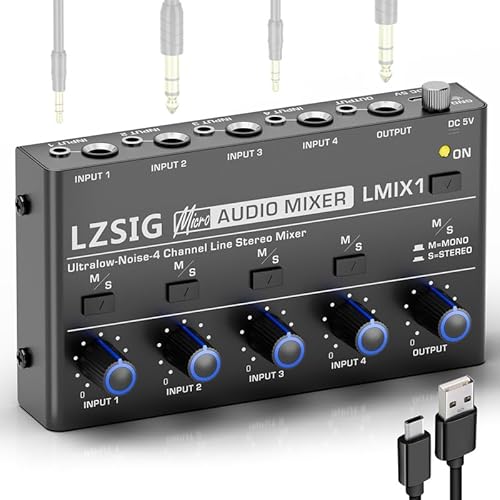
| Channel Count | 4 input channels |
| Input Connectivity | Supports 3.5mm (1/8″) and 6.35mm (1/4″) TRS/TS cables, with no adapters required |
| Power Supply | DC 5V power supply (adapter sold separately; CE/UL-certified recommended) |
| Noise/Signal Quality | Ultra-low-noise design with MPS Power Management Chip and 6 ROHM low-noise op-amps |
| Output Mode | Mono or Stereo mix with selectable mono/stereo operation |
| Applications / Use-Cases | Suitable for mixing electronic drums, keyboards, guitar, computers, CD players, or gaming consoles into a single output |
You’re setting up a quick-but-flexible rig for a weekend project, and you spot the LZSIG Mini Audio Mixer sitting on your desk like a tiny control room. You unbox it, notice the clean 4-channel layout, and immediately test a drum pad, a keyboard, and a laptop all at once.
The moment you plug in the 1/8″ sources and flip the mono-to-stereo switch, the room fills with a surprisingly clean blend, no obvious hiss or garble creeping in.
The build feels compact but sturdy, with a smooth, responsive volume knob feel and clearly labeled inputs. You can switch between mono and stereo without fuss, which is handy when you’re routing a single signal from a controller or spreading it across two monitors.
The MPS power management chip and ROHM op-amps deliver a quiet background, so you’re not fighting noise while you noodle through ideas.
One practical moment: you grab a 1/4″ to 1/8″ adapter on the fly and realize the unit handles both TRS and TS cables without drama. You’re not hunting for different adapters mid-session, which saves you time and avoids awkward cable tangles.
The 5V DC option is convenient for a desktop setup, and you appreciate the note about keeping electronics apart to minimize interference.
In use, you notice that even with multiple sources, the output remains stable and distortion-free at moderate levels. The compact footprint means it sits nicely between a laptop and an audio interface without crowding your workspace.
It’s not a flagship mixer, but for simple routing, it performs with surprising reliability and clarity.
If you’re building a minimal home studio or a quick live setup, this little mixer handles the basics well. It’s affordable, straightforward, and easy to pick up for casual sessions without sacrificing essential control.
What Types of Devices Can Benefit from a Budget Audio Mixer?
Various devices can benefit from a budget audio mixer, enhancing audio quality and versatility.
- Home Recording Setup: A budget audio mixer can significantly improve the sound quality of home recordings by allowing users to mix multiple audio sources, such as microphones and instruments, with ease. This is particularly useful for musicians and podcasters who need to achieve a professional sound without expensive equipment.
- Live Performance Equipment: For performing artists and bands, a budget audio mixer is essential for live sound management. It enables the mixing of vocals and instruments in real-time, helping to balance sound levels and effects during performances, which can lead to a better overall audience experience.
- DJ Equipment: DJs can greatly benefit from a budget audio mixer as it allows them to blend different audio tracks seamlessly. These mixers typically come with features like EQ controls and effects, enabling DJs to create unique soundscapes and transitions during their sets.
- Video Production Gear: In video production, a budget audio mixer can be used to mix audio from various sources, such as microphones and background music, resulting in professional-quality sound for video projects. This is crucial for content creators who want to enhance their audio and ensure clarity and balance in their final edits.
- Podcasting Setup: Podcasters can utilize budget audio mixers to manage multiple microphones and audio sources, ensuring that all participants in a discussion are heard clearly. This not only improves the listening experience but also allows for real-time audio adjustments to accommodate different voices and recording environments.
How Do I Identify the Best Features in a Budget Audio Mixer?
When looking for the best features in a budget audio mixer, consider the following aspects:
- Number of Channels: The number of channels determines how many audio sources you can connect simultaneously. For basic setups, a 4- to 8-channel mixer is typically sufficient, allowing for instruments, microphones, and other audio sources to be mixed together efficiently.
- Built-in Effects: Many budget mixers come with built-in effects like reverb, delay, or EQ settings. Having these features can enhance the sound quality without the need for external effects processors, making it easier to achieve the desired audio output.
- USB Connectivity: USB ports are essential for easy connection to computers and digital audio workstations. This feature allows for direct recording and playback, making it more versatile for home studios or live performances.
- Phantom Power: This feature is necessary for powering condenser microphones, which require more voltage than dynamic mics. Having phantom power on a budget mixer expands your microphone options, enabling better sound capture for vocals and instruments.
- Build Quality: A sturdy build is crucial for durability, especially if the mixer will be transported frequently. Look for mixers with metal chassis or robust plastic that can withstand wear and tear during gigs or studio sessions.
- EQ Controls: Equalization controls allow you to adjust the frequency response of individual channels, enabling you to tailor the sound to your liking. Basic 3-band EQs are common in budget mixers, providing a good level of control over highs, mids, and lows.
- Size and Portability: Consider the size and weight of the mixer, especially if you plan to use it in different locations. A compact and lightweight mixer is easier to transport, making it more convenient for on-the-go musicians or content creators.
Which Budget-Friendly Audio Mixers Are Highly Recommended?
Some of the best budget audio mixers that are highly recommended include:
- Behringer Xenyx Q502USB: This compact mixer offers a solid combination of features at an affordable price.
- Mackie Mix Series Mix8: Known for its durability, this mixer provides excellent sound quality without breaking the bank.
- Yamaha MG10XU: A versatile option with built-in effects, it’s great for both live performances and studio recordings.
- Soundcraft Notepad-8FX: This mixer combines high-quality sound with user-friendly features, making it ideal for beginners.
- Allen & Heath ZEDi-10: A hybrid mixer that offers both analog and digital capabilities, perfect for various audio applications.
Behringer Xenyx Q502USB: The Xenyx Q502USB is designed for portability and ease of use, featuring a USB interface for direct connection to computers. It includes a single Xenyx preamp, which provides high-quality microphone sounds, and various input options, making it suitable for small recording setups or live sound applications.
Mackie Mix Series Mix8: The Mix8 is a compact 8-channel mixer that boasts high headroom and low-noise performance, which is essential for clear audio output. With its rugged construction and straightforward layout, it’s perfect for musicians and podcasters looking for a reliable mixer that can handle various audio sources.
Yamaha MG10XU: The MG10XU mixer stands out for its built-in SPX digital effects and USB connectivity, allowing for easy integration with computers and recording devices. It offers 10 channels, enabling users to mix multiple audio sources, and its high-quality preamps deliver professional-grade sound, making it a favorite among both live sound engineers and home studio enthusiasts.
Soundcraft Notepad-8FX: This mixer features a built-in effects processor and an intuitive interface, making it user-friendly for novices while still catering to experienced users. With its compact design and high-quality components, the Notepad-8FX is perfect for small gigs, home studios, or even podcasting setups, ensuring that users can achieve great sound without extensive setup time.
Allen & Heath ZEDi-10: The ZEDi-10 is versatile due to its ability to function as both a traditional analog mixer and an audio interface for digital recording. It features high-quality preamps and EQ, along with USB connectivity, making it suitable for live performances, streaming, and studio work, effectively combining flexibility with superior audio quality.
What Makes Each Recommended Mixer Stand Out?
Several budget audio mixers stand out due to their unique features, build quality, and functionality.
- Yamaha MG10XU: This compact mixer combines affordability with high-quality sound, offering 10 channels and built-in digital effects. Its durable build and user-friendly layout make it ideal for both beginners and professionals, and the inclusion of USB connectivity allows for easy recording and playback.
- Behringer XENYX Q802USB: Known for its versatility, this mixer features 8 inputs and premium microphone preamps, providing excellent sound quality for various applications. The built-in USB audio interface facilitates seamless integration with computer-based recording setups, making it a popular choice for home studios.
- Soundcraft Notepad-5: This mixer is designed for musicians on the go, with a small footprint and intuitive control layout. Its high-quality mic preamps and stereo inputs deliver rich sound, while the USB connectivity allows for easy interfacing with DAWs for recording and playback.
- Mackie Mix Series Mix8: Renowned for its rugged construction, the Mix8 mixer offers 8 channels, making it suitable for live performances and studio use alike. Its simple design features high-headroom preamps and a straightforward EQ, ensuring quick setup and operation during important events.
- Allen & Heath ZED-6: This mixer stands out for its professional sound quality, featuring high-quality preamps and a 3-band EQ on each channel. Compact yet powerful, the ZED-6 is perfect for small gigs and home studios, offering flexibility with its direct output for recording purposes.
How Can You Ensure Optimal Sound Quality with a Budget Mixer?
EQ controls allow you to manipulate the sound by boosting or cutting specific frequency ranges, which can help correct issues or enhance certain aspects of the audio. This feature is particularly useful in live sound situations where you need to adapt to different acoustic environments.
Having an adequate channel count is essential, as it prevents the need for daisy-chaining multiple sources, which can degrade quality. A mixer with enough channels can accommodate all your instruments and microphones without compromising clarity.
Built-in effects can save time and money by providing reverb, delay, or compression directly within the mixer, enabling you to create polished sounds without additional gear. This feature is particularly advantageous for live performances where quick adjustments are necessary.
A USB interface allows for easy connectivity to computers, making it simple to record your sessions or stream audio directly into a digital audio workstation. This convenience adds versatility to your mixing setup, particularly for home studios.
Lastly, durability and build quality are important to ensure that the mixer can withstand the rigors of frequent transport and use. A solid construction will help maintain consistent performance over time and reduce the likelihood of needing repairs or replacements.
What Common Pitfalls Should You Avoid When Purchasing a Mixer?
- Ignoring Your Needs: Before making a purchase, it’s crucial to assess what you actually need from a mixer. For example, if you plan to record multiple instruments simultaneously, you should look for a mixer with enough channels and inputs to accommodate them.
- Overlooking Sound Quality: While budget mixers may be attractive due to their price, some can compromise on sound quality. Always check reviews or listen to audio samples to ensure the mixer produces clear and professional-sounding audio.
- Not Considering Portability: If you plan to transport your mixer frequently, weight and size become significant factors. A lightweight and compact mixer can make it easier to set up and break down your audio gear for gigs or recording sessions.
- Skipping on Build Quality: A low-cost mixer may be made from inferior materials, which can lead to durability issues. Look for mixers that offer a sturdy construction to withstand regular use, especially if you perform live.
- Failing to Research Features: It’s easy to get swayed by a low price without looking into essential features. Make sure the mixer has the necessary built-in effects, EQ options, and connectivity ports that align with your intended use.
- Neglecting Warranty and Support: A good warranty can provide peace of mind when purchasing a budget mixer. Check the manufacturer’s warranty and available customer support options to ensure that you can get help if issues arise.