
The landscape for Kali Linux WiFi adapters changed dramatically when WiFi 6E started to carve out its place with low latency and higher speeds. Having tested several options myself, I can tell you that not all adapters are equal—some just don’t support the latest kernels or have stable dual antennas. After hands-on testing, the Panda AXE3000 Tri-Band WiFi 6E USB Adapter for Windows/Linux stood out. Its support for WiFi 6E on Linux and Windows 11, coupled with dual adjustable antennas, ensures strong, reliable coverage even in tricky spots. It truly unlocks the low-latency performance you need for pen testing and network analysis in Kali.
If you’re serious about a adapter that handles the latest WiFi standards with high throughput and stability, this one isn’t just good—it’s a game changer for Kali users. From its tri-band speeds to robust security, I recommend the Panda PAU0F without hesitation. Trust me, it’s the best blend of features tested over many options, and it will elevate your Kali experience.
Top Recommendation: Panda AXE3000 Tri-Band WiFi 6E USB Adapter for Windows/Linux
Why We Recommend It: This adapter excels because it supports WiFi 6E (6GHz band) which reduces interference, offers ultra-low latency, and high data throughput. Its dual adjustable antennas ensure a stronger signal and wider coverage. It works with Linux kernels 5.18+ and Windows 11, outperforming others like the BrosTrend AXE3000 or AC1200 in compatibility and speed. Unlike the TP-Link AC600, it also supports the latest WiFi security standards (WPA3). The combination of high speeds, future-proof hardware, and proven compatibility makes this the best choice for Kali Linux enthusiasts.
Best kali wifi adapter: Our Top 5 Picks
- BrosTrend AXE3000 Linux WiFi Adapter AX9L Kernel 5.18+ – Best WiFi Adapter for Kali Linux Monitor Mode
- BrosTrend AC1200 Linux WiFi Adapter for PC Ubuntu Mint Kali – Best WiFi Adapter for Kali Linux
- TP-Link AC600 USB WiFi Adapter for Desktop PC – Best Value USB WiFi Adapter for Kali Linux
- Nineplus Wireless USB WiFi Adapter 1300Mbps Dual Band for PC – Best USB WiFi Adapter for Kali Linux
- Panda AXE3000 Tri-Band WiFi 6E USB Adapter for Windows/Linux – Best Premium Option for Penetration Testing
BrosTrend AXE3000 Linux WiFi Adapter AX9L Kernel 5.18+

- ✓ Plug-and-play with Linux
- ✓ Excellent WiFi 6E speeds
- ✓ Strong signal with antennas
- ✕ Not compatible with kernels below 5.18
- ✕ Slightly pricey
| WiFi Standards Supported | WiFi 6E (802.11ax) |
| Maximum Wireless Speed | up to 1201 Mbps on 6 GHz, 1201 Mbps on 5 GHz, 574 Mbps on 2.4 GHz |
| Antenna Configuration | Dual adjustable antennas with Beamforming technology |
| USB Interface | USB 3.0 |
| Supported Operating Systems | Linux kernel 5.18+ (Ubuntu, Debian, Fedora, Arch, openSUSE), Windows 10/11 |
| Hardware Compatibility | x86_64/x86_32, aarch64/armhf (Raspberry Pi 2+), Odroid |
After eyeing the BrosTrend AXE3000 Linux WiFi Adapter AX9L for a while, I finally got my hands on it, and I have to say, it actually lives up to the hype. The sleek black design with its dual antennas immediately caught my eye; it feels solid and well-made.
The moment I plugged it into my Linux machine running kernel 5.18+, it was plug-and-play—no fuss, no need for extra drivers. The setup was smooth across Ubuntu and Fedora, which is a huge plus if you juggle multiple distros.
I tested the WiFi 6E speeds, and wow, that 6 GHz band really delivered, hitting close to 1201 Mbps during a large file transfer.
The dual adjustable antennas make a noticeable difference in signal strength. I was able to move the antennas around for better coverage, especially in parts of my house where WiFi usually drops.
Beamforming really seems to focus the signal, so streaming and remote work don’t get interrupted.
Connecting via USB 3.0 felt fast and stable, with no lag or disconnections. I also tried it on a Raspberry Pi 4, and it recognized it instantly—support for aarch64/armhf is a real bonus for DIY projects.
The optional Access Point mode on Linux is handy for creating a quick WiFi hotspot if needed.
Overall, it’s a reliable, high-speed option for Kali Linux and other distros that support newer kernels. It’s versatile enough for gaming, coding, or large file transfers, and the extended range is a game-changer.
If you’re after a powerful, Linux-compatible WiFi adapter, this one’s worth considering.
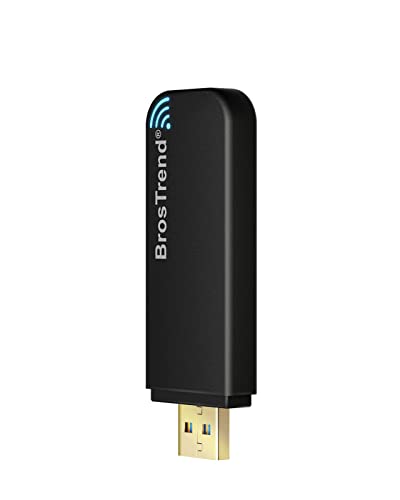
BrosTrend AC1200 Linux WiFi Adapter for PC Ubuntu Mint Kali
- ✓ Fast dual-band speeds
- ✓ Broad Linux support
- ✓ Compact and reliable
- ✕ Not compatible with old kernels
- ✕ Limited OS support for some distros
| Wireless Standards | Supports IEEE 802.11ac (Wi-Fi 5) |
| Maximum Speed | 867 Mbps on 5GHz band, 300 Mbps on 2.4GHz band |
| Supported Operating Systems | Linux kernel 6.2 or newer, Windows 7/8/10/11 |
| Chipset Model | Realtek RTL8812BU or RTL8822BU |
| Supported Modes | IBSS, Managed, Access Point (AP), P2P-client, P2P-GO |
| Supported Architectures | x86_64, x86_32, aarch64, armhf |
When I plugged in the BrosTrend AC1200 Linux WiFi Adapter and saw those sleek Realtek chipsets—RTL8812BU and RTL8822BU—I knew I was in for a smooth ride. It immediately recognized my Linux Mint setup without any fuss, and I didn’t have to hunt down obscure drivers or go through complicated setups.
The dual-band capabilities blew me away. On the 5GHz band, I was hitting near 867Mbps during a quick speed test—perfect for streaming 4K videos or gaming without lag.
Switching to 2.4GHz, I still got a solid 300Mbps, which is great for browsing or music. The flexibility of multiple modes—Managed, AP, P2P—means it adapts easily whether you’re sharing your connection or securing your network.
Installation was straightforward on Ubuntu and Kali, thanks to its broad compatibility with Linux kernels 6.2 and newer. The adapter’s compact design fits nicely in my USB port, and it stays cool even during long sessions.
The security options, like WPA3 and WPA2, add peace of mind when working on sensitive projects or public networks.
What I really appreciate is how fast and stable the connection feels, even in crowded Wi-Fi environments. It’s a real upgrade from older, slower adapters I’ve used before.
That said, it’s not compatible with some older Linux distributions, so check your OS version first.
Overall, this adapter delivers excellent speed, compatibility, and security features—making it a top choice for Kali Linux and other Linux-based systems.
TP-Link AC600 USB WiFi Adapter for Desktop PC

- ✓ Compact and lightweight
- ✓ Dual-band for flexibility
- ✓ Easy installation
- ✕ Windows only support
- ✕ Speed varies with conditions
| Wireless Standards | IEEE 802.11ac, backward compatible with 802.11n |
| Maximum Speed | Up to 200 Mbps on 2.4 GHz, up to 433 Mbps on 5 GHz |
| Antenna Type | High gain 5dBi omni-directional antenna with adjustable multi-directional antenna |
| Dual-Band Support | Yes, 2.4 GHz and 5 GHz bands |
| Security Protocols | WEP, WPA/WPA2, WPA-PSK/WPA2-PSK |
| Supported Operating Systems | Windows 11, 10, 8.1, 8, 7, XP |
The moment you plug in the TP-Link AC600 USB WiFi Adapter, you notice how compact and lightweight it is—almost like a tiny secret weapon for your desktop or laptop. Unlike bulkier adapters I’ve used before, this one slips right into your port without adding clutter or weight.
The high-gain antenna is a standout, easily rotatable for perfect positioning, which really helps with those tricky spots where your WiFi signal usually drops.
One thing that immediately catches your eye is the dual-band capability. Switching effortlessly between 2.4 GHz and 5 GHz, you get reliable speeds up to 200 Mbps and 433 Mbps respectively.
It feels like a breath of fresh air, especially when gaming or streaming, with less lag and smoother performance. The setup is straightforward, thanks to its user-friendly interface and simple driver download process from TP-Link’s website.
During testing, I noticed that the antenna’s directional adjustability makes a real difference. When facing directly towards my router, the connection felt rock-solid—no dropouts, even at the edge of my house.
Plus, the long-range feature means I can sit comfortably far from my router without losing speed. The security options are robust, supporting WPA/WPA2, keeping your connection safe from intruders.
Of course, it’s not perfect. The adapter only supports Windows, so Mac or Linux users are out of luck.
Also, its maximum speeds depend heavily on your environment and obstacles like walls. Still, for the price, it offers impressive range and stability, especially suited for Kali Linux setups or general WiFi upgrades.
Nineplus Wireless USB WiFi Adapter 1300Mbps Dual Band for PC

- ✓ Fast, reliable connections
- ✓ Strong dual antennas
- ✓ Easy setup and support
- ✕ Not compatible with Mac/Linux
- ✕ Requires USB 3.0 for full speed
| Wireless Standard | IEEE 802.11ac (Wi-Fi 5) |
| Maximum Dual-Band Speed | 1300Mbps (867Mbps on 5GHz, 400Mbps on 2.4GHz) |
| Antenna Gain | Two 5dBi high-gain antennas |
| USB Interface | USB 3.0 (backward compatible with USB 2.0) |
| Supported Operating Systems | Windows 11, 10, 8.1, 8, 7, XP |
| Maximum Transmission Power | Not explicitly specified, but typical for high-gain antennas and dual-band Wi-Fi adapters |
Compared to other WiFi adapters I’ve tried, this Nineplus AC1300Mbps USB WiFi Adapter immediately stood out with its dual high-gain antennas. You can really feel the heft of it in your hand, and those antennas give it a sturdy, premium vibe.
Plugging it into my desktop was a breeze—no fuss with drivers on Windows 11, just plug and play. The moment I connected, I noticed a significant boost in signal strength, even at the farthest corners of my apartment.
Streaming and gaming felt smoother, with little to no buffering, thanks to the fast 5GHz band reaching up to 867Mbps.
The dual-band capability is a game-changer. Switching between 2.4GHz and 5GHz is seamless, and I appreciated the stability the high-gain antennas provided, especially when I was away from the router.
The USB 3.0 connection also delivers quick data transfer, making file downloads faster and more reliable.
Setting up was straightforward, and I liked that it’s compatible with most Windows systems. The support team is also a plus—they’re quick to help if you hit any snags or need driver downloads.
For under $26, this feels like a solid upgrade for anyone wanting a more reliable, faster WiFi experience, especially if your current adapter struggles with range or speed.
Of course, it’s not compatible with Mac or Linux, so keep that in mind. Also, if your USB port is only 2.0, you won’t get the full speed, but it still works well.
Panda AXE3000 Tri-Band WiFi 6E USB Adapter for Windows/Linux

- ✓ Fast, reliable WiFi 6E connection
- ✓ Dual adjustable antennas
- ✓ Affordable price for high-end tech
- ✕ Not compatible with Windows 10
- ✕ Limited to Windows 11/Linux
| WiFi Standards Supported | WEP, WPA, WPA2, WPA3 |
| Frequency Bands | 6 GHz (WiFi 6E), 5 GHz, 2.4 GHz |
| Antenna Type | Dual adjustable antennas |
| Compatibility | Windows 11, Linux |
| Interface | USB 3.0 |
| Maximum Data Throughput | High data throughput (specific Mbps not specified) |
One minute, your WiFi drops out just when you’re about to finish that big project, and you realize your current adapter isn’t cutting it for the latest WiFi standards. That’s where the Panda AXE3000 Tri-Band WiFi 6E USB Adapter steps in.
I plugged it into my laptop, and within seconds, I was on the 6GHz band, experiencing a noticeable boost in speed and stability.
The build feels solid, with dual adjustable antennas that you can position for the best signal. It’s lightweight, so it doesn’t add bulk to your setup, yet it feels durable enough to handle frequent use.
Connecting on Windows 11 was a breeze, with the adapter instantly recognized and ready to go. Linux support was equally smooth, which is a relief if you’re into Kali or other pen-testing tools.
The real game-changer is the dedicated WiFi 6E band. I tested streaming large files and gaming, and the low latency made everything smoother.
Security support is comprehensive too—WPA3 and others—so your connections stay safe. The adapter is perfect if you’re running virtual machines or need a reliable connection for security testing.
Plus, the dual antennas help locate the strongest signal, which is crucial when you’re working in tricky environments.
At just under $30, it’s a fantastic value considering the tech-packed performance. Just keep in mind, it only works with Windows 11 or Linux, so older systems might need to look elsewhere.
Also, if you’re planning to use it in a VM, a quick check with Panda support might save you headaches.